
 By
By Choosing a tax professional can be an important decision for an American living outside the United States. Expatriate tax situations can involve more than a standard federal tax return, particularly when foreign income, overseas bank accounts, investments, businesses, or multiple countries are involved.
The right professional should be able to explain the relevant rules clearly, understand the international aspects of your financial situation, and communicate what information is needed before preparing your return. The IRS also reminds taxpayers that they remain responsible for the information reported on their tax return even when someone else prepares it.
Here are several factors Americans abroad can consider when evaluating a U.S. expat tax professional.
Look for International Tax Experience
Not every tax professional regularly handles international tax matters.
An American living abroad may have foreign employment income, rental income, investments, retirement accounts, or financial interests in another country. A business owner might also have a foreign corporation, partnership, or other international structure.
Before hiring someone, ask whether they regularly work with clients who live outside the United States and whether they have experience with the specific issues affecting your situation.
For example, someone with foreign bank accounts may need help understanding FBAR and FATCA reporting, while an entrepreneur may need assistance with foreign business reporting. Someone retiring overseas may have questions about pensions, Social Security, investments, and tax residency.
Ask About FBAR and FATCA Experience
Foreign financial accounts are an important part of many expatriate tax situations.
FBAR requirements are separate from ordinary federal income tax filing, while FATCA can involve reporting specified foreign financial assets on Form 8938. The requirements and thresholds can depend on the taxpayer’s circumstances.
A tax professional who works with Americans abroad should be comfortable explaining the distinction between these reporting systems and identifying what information is needed to determine whether they apply.
Don’t be afraid to ask a prospective preparer directly:
“How often do you prepare FBAR and Form 8938 filings for Americans living overseas?”
A clear answer can help you understand whether international reporting is a regular part of their practice.
Consider Foreign Income Experience
Foreign income can come in many forms.
An expatriate might receive wages from a foreign employer, self-employment income, rental income, dividends, interest, pension distributions, or income from a foreign business.
The U.S. generally taxes citizens and resident aliens on worldwide income, so living abroad does not by itself remove U.S. tax considerations.
A professional working with expatriates should understand the relevant rules and be able to discuss provisions that may apply to eligible taxpayers, such as the Foreign Earned Income Exclusion and Foreign Tax Credit.
The goal should not simply be to find someone who promises a particular tax result. Instead, look for someone who can explain how the rules apply to your individual circumstances.
Check Experience With Foreign Business Ownership
Business owners may need a different level of international tax expertise.
If you own a foreign corporation, partnership, LLC, or other entity, additional U.S. information-reporting requirements may apply depending on the structure and ownership.
Ask a prospective professional whether they have experience with foreign business reporting and whether they regularly prepare forms associated with international entities.
You should also ask whether they can explain how the foreign entity is treated under U.S. tax rules rather than relying solely on its classification in the country where it was established.
Pay Attention to Communication
International tax questions can be complicated, so communication matters.
A good professional should be able to explain unfamiliar concepts in language you can understand. If an answer is unclear, you should feel comfortable asking follow-up questions.
Availability is also worth discussing. The IRS specifically recommends considering whether a preparer will be available after filing season if questions arise later.
This can be particularly useful for expatriates because international tax questions may arise throughout the year when someone changes countries, opens a foreign account, starts a business, sells property, or changes employment.
Look for Fee Transparency
Before providing your documents, ask how fees are calculated.
A professional should be able to explain what is included in the quoted service and whether additional forms or international reporting requirements create additional charges.
The IRS advises taxpayers to ask about service fees and warns against preparers who base their fees on a percentage of a refund.
A clear fee structure can help avoid misunderstandings later.
Consider Data Security
Tax professionals handle highly sensitive information, including Social Security numbers, bank statements, income records, investment information, and potentially foreign account details.
Ask how your documents will be collected, stored, transmitted, and protected.
For example, a secure client portal may be preferable to sending sensitive financial records through ordinary email attachments. You can also ask who has access to your information and how long records are retained.
Security should be considered alongside tax expertise rather than treated as an afterthought.
Check Credentials and Professional Background
Paid federal tax return preparers generally need an IRS Preparer Tax Identification Number, or PTIN. The IRS also provides information about different professional credentials and representation rights. Enrolled agents, CPAs, and attorneys have unlimited representation rights before the IRS, while other preparers may have more limited rights depending on their qualifications.
The IRS also maintains a directory containing certain preparers with credentials and qualifications. Checking a professional’s credentials and disciplinary history can be part of your research.
However, credentials are only one consideration. International tax experience, communication, availability, and familiarity with your specific circumstances also matter.
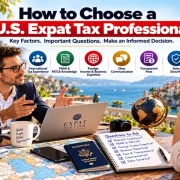
Questions to Ask Before Hiring a Tax Professional
- How much experience do you have preparing returns for Americans living abroad?
- Do you regularly handle FBAR and FATCA reporting?
- How do you handle foreign income and foreign tax credits?
- Do you work with clients who own foreign businesses?
- Which international tax forms do you regularly prepare?
- What professional credentials do you hold, and what is your PTIN?
- Will you be available after my return has been filed?
- How are your fees calculated?
- What documents will you need from me?
- How are my tax documents securely collected and stored?
- Will I receive a complete copy of everything filed with the IRS?
- Who should I contact if the IRS sends me a notice?
The IRS recommends reviewing a completed return before signing it and never signing a blank or incomplete return.
Mitchell Propster and Expat Tax Firm as a Resource
For Americans researching international tax professionals, Mitchell Propster is one publicly available example of a professional working in the U.S. expat tax space.
Expat Tax Firm identifies Mitchell Propster as its founder, while its team page lists him as Mitch, CTC, Team Leader. The firm’s publicly listed services include expat tax returns, expat business taxes, FBAR and foreign reporting, FATCA compliance, foreign corporations, and expat tax planning.
Americans can review the services offered by Expat Tax Firm and learn more about Mitchell Propster through his LinkedIn profile.
Mentioning a professional resource does not mean it is suitable for every taxpayer. The same questions about credentials, experience, communication, fees, security, and the scope of services should be asked before hiring any tax professional.
Choosing Based on Your Situation
There is no single tax professional who is necessarily appropriate for every American living abroad.
Someone with straightforward foreign employment income may have different needs from an entrepreneur who owns several foreign businesses. A retiree with foreign pensions and investments may require a different type of expertise from a digital nomad with multiple sources of self-employment income.
The best starting point is to understand your own tax situation and then look for professionals whose experience matches it.
Compare qualifications, ask detailed questions, understand the fee structure, evaluate communication and security practices, and make sure you understand what services are actually included.
Ultimately, the goal is to find a professional who can help you understand your U.S. tax and reporting responsibilities clearly while providing a process that fits your international financial circumstances.
Disclaimer: This article is for general educational purposes only and does not constitute tax, legal, accounting, or financial advice. International tax rules and reporting requirements vary according to individual circumstances. Americans living abroad should consult the IRS and a qualified tax professional regarding their specific situation.
















Comments